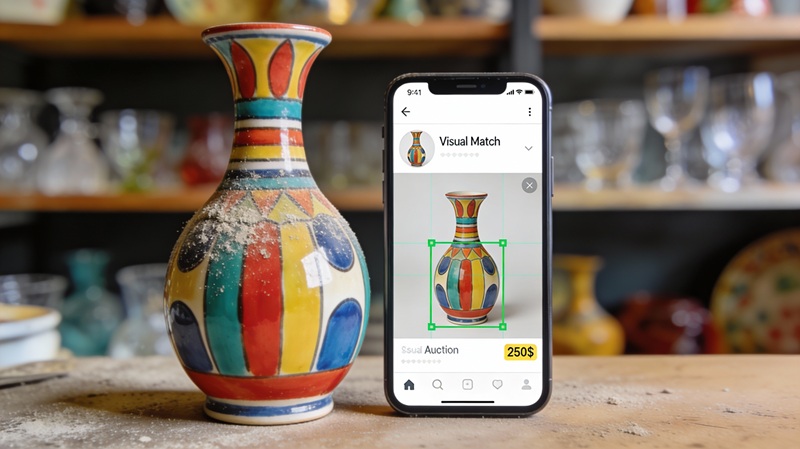
How much is it worth? That is the first question that matters when a thrift find, estate sale box, or marketplace listing looks promising. In plain reseller language, people also ask how much it’s worth, what’s it worth, or what is this worth. You’re standing in a thrift store holding a vintage camera. The price tag says $12. It looks old-maybe valuable? You pull out your phone, search “vintage camera values,” and get 47 million results. Twenty minutes later you’re more confused than when you started.
This is the reseller’s dilemma: How do you know what something is actually worth before you buy it?
I’ve watched new resellers make the same mistakes over and over: buying based on gut feeling, overpaying for items that “look valuable,” or worse-passing on goldmines because they didn’t know how to check comps. One reseller I know passed on a Pyrex bowl for $4 because “it’s just a bowl.” That bowl was a rare Turquoise Butterprint worth $180.
The difference between profitable resellers and broke ones isn’t luck-it’s knowing how to accurately value items in under 2 minutes. This guide shows you exactly how to do that, whether you’re evaluating a vintage t-shirt, a piece of electronics, or something you can’t even identify.
In this guide, you’ll learn:
- The 5 reliable methods to find what anything is worth (and when to use each)
- How to use eBay sold listings like a pro (the 90-second research technique)
- Category-specific valuation strategies for clothing, electronics, collectibles, and more
- Red flags that scream “this isn’t worth what you think”
- The exact 2-minute process I use to decide buy or pass on any item
Table of Contents
- The 5 Ways to Find What Something Is Worth
- How Much Is It Worth? The Fast Answer
- What’s It Worth? Buyer Value vs Seller Value
- Method 1: eBay Sold Listings (The Gold Standard)
- Method 2: Google Lens for Instant Identification
- Method 3: Price Guide Apps and Databases
- Method 4: AI Valuation Tools
- Method 5: Professional Appraisers (When to Pay the Expert)
- Category-Specific Valuation Guides
- Red Flags: When Something Isn’t Worth What You Think
- How to Check How Much Is It Worth in 2 Minutes
- What’s It Worth? The Buy-or-Pass Math
- Common Valuation Mistakes That Cost Money
- Frequently Asked Questions
The 5 Ways to Find What Something Is Worth
There are only five truly reliable methods to determine an item’s market value. Everything else is guessing.
How Much Is It Worth? The Fast Answer
An item is worth what a real buyer has recently paid for the same item in similar condition. Start with sold listings, not active asking prices. Then adjust for condition, shipping, fees, season, and how fast you need the cash back.
For most resale items, I use a working range instead of one magic number:
| Value layer | What it means | How I use it |
|---|---|---|
| Sold-comp value | Recent sales for the same item | Sets the realistic market range |
| Net resale value | Sale price minus fees, shipping, and supplies | Shows what comes back to you |
| Maximum buy price | The most you can pay and still make profit | Decides buy or pass |
| Fast-sale price | Low end of the sold range | Moves stale inventory or local pickups |
If a vintage Sony receiver sells for $160 to $210, it is not automatically “worth $210.” If shipping is $35, eBay fees land near the low-to-mid teens, and you paid $90, the flip may be thinner than it looks. The clean answer to how much is it worth is the number a buyer will pay, but the reseller answer is the number left after the sale still pays you.
That is why I check value in two passes. First I find the market price. Then I run the profit math with the flip profit calculator or a quick spreadsheet before buying. Gross value gets attention. Net value keeps you in business.
Quick Comparison
| Method | Speed | Accuracy | Best For | Cost |
|---|---|---|---|---|
| eBay Sold Listings | 30-90 sec | Very High | Most items | Free |
| Google Lens | 10-30 sec | High (ID only) | Unknown items | Free |
| Price Guide Apps | 20-60 sec | High | Books, video games, collectibles | Free-$10/mo |
| AI Valuation Tools | 5-15 sec | High | General items with photos | Free-$6/mo |
| Professional Appraisers | Days | Very High | High-value antiques, art, jewelry | $50-500+ |
The Rule: For 95% of thrift store/marketplace finds, eBay sold listings + Google Lens is all you need. The other methods fill specific gaps.
What’s It Worth? Buyer Value vs Seller Value
When someone asks “what’s it worth?” they usually want one clean number. Resellers need three numbers, because the buyer’s number, the seller’s number, and your profit number are rarely the same.
The mistake is treating the highest comp as truth. If a vintage receiver has sold for $210 once, $185 twice, and $155 five times, the item is not a $210 item for sourcing purposes. It is a $155 to $190 item unless you have the same model, the same condition, the same accessories, and enough patience to wait for the top-end buyer.
Use this split before you pay:
| Question | Number to Use | Why It Matters |
|---|---|---|
| What did buyers recently pay? | Median sold comp | Sets the market floor and ceiling |
| What will I keep after fees? | Sale price minus fees and shipping | Turns value into cash |
| What can I safely pay? | 30-40% of likely resale | Keeps margin after mistakes |
| What price moves it fast? | Low clean comp | Useful for local pickup or stale stock |
| What price needs patience? | High clean comp | Only use when condition is better than average |
Here is the field version. A $120 comp does not mean you can pay $80. If eBay fees land near 13.6% in many common categories, the order fee adds $0.40 on orders over $10, packing costs $2, and shipping risk sits on you, the real reseller value might support a $35 to $45 buy. That is still a good flip if the item is clean. It is a bad flip if you let the headline comp talk you into paying collector price.
For general categories, start with the eBay sold comps shortcut tool. For net profit, run the likely sale through the flip profit calculator. For condition-sensitive finds like Pyrex, sneakers, trading cards, and designer bags, check the condition grade impact calculator before you trust a top comp.
Method 1: eBay Sold Listings (The Gold Standard)
eBay sold listings show you what items actually sold for, not what sellers hope to get. This is the most accurate free valuation method available.
Why Sold Listings Beat Everything Else
- Real market prices: These are completed transactions with actual buyers
- Condition comparison: You can see exactly what condition items sold in
- Timing data: Recent sales (last 30-90 days) reflect current demand
- Volume indicators: 50 recent sales means stable market; 2 sales means risky flip
Active listings lie. Someone can list a $10 mug for $500. It doesn’t mean it’s worth $500. Only sold listings tell the truth.
The 90-Second eBay Sold Listings Technique
Here’s my exact process for checking comps in under 90 seconds:
Step 1: Get specific with your search terms (10 seconds)
Bad search: “vintage camera”
Good search: “Canon AE-1 35mm SLR camera black”
Include:
- Brand/maker
- Model number or specific style
- Key identifiers (color, size, era)
- Condition indicators (if visible)
Step 2: Filter to sold listings (5 seconds)
On eBay’s search results:
- Click “Advanced” next to the search bar
- Under “Search including,” check “Sold listings”
- Or use this shortcut: Add
&LH_Sold=1to any eBay search URL
Step 3: Scan the first 20 results (60 seconds)
Look for:
- Price range: What’s the typical selling price? (ignore outliers)
- Sell-through rate: Are there 5 recent sales or 100? High volume = proven demand
- Condition variance: How much more do “excellent” items sell for vs “good”?
- Shipping costs: Are sellers charging $8 or $25 to ship?
Step 4: Calculate your target buy price (15 seconds)
Formula: Median sold price × 0.40 = Maximum buy price
Example:
- Vintage Nike windbreaker sold comps: $45, $52, $58, $48, $55
- Median: $52
- Maximum buy price: $52 × 0.40 = $20.80
If the thrift store price is $22, it’s a pass. If it’s $12, it’s a buy.
The 0.40 multiplier accounts for:
- Platform fees (~16% on eBay)
- Shipping costs (~12-15%)
- Your profit margin (minimum 2x ROI)
Pro Tips for eBay Sold Listings
Tip 1: Sort by “Newly Listed” to see actual recent demand
Default sort shows highest-priced sales first, which skews perception. Sort by “Time: Newly Listed” to see chronological sales and spot trends (prices rising or falling?).
Tip 2: Check “completed listings” vs “sold listings”
“Completed” includes unsold items (listings that expired). “Sold” is what you want-actual sales only.
Tip 3: Use the eBay Sold Link Generator for speed
Manually filtering to sold listings every time wastes 20-30 seconds. Generate a direct link to sold listings with one click.
Try the eBay Sold Link Generator →
Just paste your search term, select your region (US/Canada/UK/EU), and get instant links to eBay sold listings, Mercari sold, Poshmark, and Terapeak research.
Tip 4: Watch for seasonal variance
Winter coats sell for 3x more in October than April. Christmas decorations spike in November. If you’re checking comps in March for a winter item, look at sales from Oct-Feb (the previous season).
Method 2: Google Lens for Instant Identification
Google Lens is a game-changer for items you can’t identify. Point your phone camera at an object, and Google shows you what it is, where it’s sold, and often what it’s worth.
When Google Lens Wins
- Unknown brands or unmarked items: “What is this logo?”
- Collectibles with no visible markings: Vintage glassware, pottery, figurines
- Designer items you suspect are fake: Visual match to authentic versions
- Foreign or old text: Translates and identifies vintage labels
How to Use Google Lens for Valuations
Step 1: Open Google Lens
- Android: Open Google Photos, tap any photo, tap the Lens icon
- iPhone: Download the Google app, tap the camera icon in search bar, select Lens
- In-store: Point camera at the item directly (no photo needed)
Step 2: Frame the most distinctive part
- For clothing: The brand tag or any unique design elements
- For dishware: The pattern and any maker’s marks on the bottom
- For electronics: Model numbers or brand logos
- For collectibles: The most unique visual feature
Step 3: Review visual matches
Google shows similar images from across the web. Look for:
- Exact matches on retail sites (shows MSRP for new)
- Matches on eBay, Mercari, Etsy (shows resale market)
- Blog posts or collector guides (shows rarity info)
Step 4: Cross-reference with eBay sold listings
Google Lens identifies what it is. eBay sold listings tell you what it’s worth. Always verify Lens results with actual sold comps.
Real Example: Pyrex Mystery Bowl
You find a turquoise glass bowl with no visible markings. Tag says $3.
- Google Lens the pattern → Matches “Pyrex Turquoise Butterprint 403”
- Search eBay sold listings for “Pyrex Butterprint 403 turquoise”
- Recent sales: $120, $145, $165, $180 (excellent condition)
- Buy immediately at $3
That’s a $115-175 profit from a 45-second Lens search.
Method 3: Price Guide Apps and Databases
For specific categories with established price databases, specialized apps beat eBay for speed and accuracy.
Best Apps by Category
Books: BookScouter
- Scans ISBN barcodes
- Shows buyback prices from 30+ book buyers
- Instant valuation (5 seconds per book)
- Best for: Textbooks, collectible books, recent releases
Video Games: PriceCharting
- Complete game price database (NES to PS5)
- Historical price charts
- Tracks loose, complete, and sealed values separately
- Best for: Retro games, sealed games, strategy guides
Trading Cards: TCGPlayer, eBay 130point.com
- TCGPlayer for Pokémon, Magic, Yu-Gi-Oh values
- 130point.com for sports cards (aggregates eBay sold data)
- Best for: Graded cards, specific card sets
Comics: GoCollect, Key Collector
- GoCollect tracks graded comic sales
- Key Collector identifies first appearances and key issues
- Best for: Silver Age and older comics, key issues
Collectibles: WorthPoint
- Massive database of sold auctions and price guides
- Requires subscription ($30-40/month)
- Best for: Antiques, pottery, glassware, estate sale finds
When to Use Apps vs eBay
Use price guide apps when:
- The category has standardized items (books with ISBNs, games with UPCs)
- You need speed (scanning 50 books at a thrift store)
- You’re evaluating rare/collectible variants
Use eBay when:
- The item is one-of-a-kind or vintage
- Condition heavily affects value (clothing, electronics)
- You need to see shipping costs and actual sell-through
Method 4: AI Valuation Tools
AI tools analyze photos and compare against market data to estimate value instantly. They’re fastest for general items but less accurate for rare/unusual finds.
How AI Valuation Works
- You upload a photo or link to a marketplace listing
- AI identifies the item (brand, model, condition)
- AI pulls recent sold comps from multiple platforms
- AI estimates fair market value and profit potential
Accuracy: 80-90% for common items, 60-70% for rare/vintage items (always verify high-value finds manually).
When AI Tools Shine
- Marketplace sourcing: Analyzing 20 Facebook Marketplace listings in 5 minutes
- Multi-item evaluation: Checking a box lot or bundle quickly
- Beginner-friendly: Don’t know what questions to ask? AI does it for you
Underpriced: Built for Resellers
Full disclosure: Underpriced is an AI valuation tool built specifically for resellers. Here’s how it works:
- Paste a Facebook Marketplace, Craigslist, or OfferUp link
- AI analyzes the photo, title, and description
- Pulls live eBay sold comps for each item
- Calculates profit after platform fees and shipping
- Flags red flags (damaged, fake, incomplete, overpriced)
Example output:
“Sony PlayStation 4 Pro 1TB - $180 asking price. Recent eBay sales: $220-260. After fees/shipping: $35-75 profit. Moderate ROI. ✅ Deal if works + has cables.”
Try Underpriced Free → (10 free analyses, no credit card)
Limitations of AI Tools
AI struggles with:
- Rare/vintage items with few recent comps
- Authentication (can’t tell real from fake without physical inspection)
- Condition subtleties (scuffs, odors, functionality issues photos don’t show)
- Local market variance (what sells in NYC may not in rural Iowa)
Always visually inspect items AI flags as valuable. Never buy sight-unseen based solely on AI valuation.
Method 5: Professional Appraisers (When to Pay the Expert)
Professional appraisals cost $50-500+ but are worth it for high-value items where accuracy matters.
When You Need an Appraiser
- Fine art over $1,000 (authentication + market value)
- Jewelry with precious metals or stones (gemologist for grading)
- Antiques from estate sales (period verification, provenance)
- Rare collectibles over $2,000 (authentication critical)
- Insurance purposes (need certified appraisal for coverage)
Types of Appraisers
General antiques appraisers:
- Broad knowledge across furniture, ceramics, glassware
- Cost: $75-150/hour or $25-50 per item
- Find via: American Society of Appraisers, local auction houses
Specialist appraisers:
- Deep expertise in one category (coins, watches, stamps, art)
- Cost: $100-500+ per item
- More accurate for rare/high-value pieces
Online appraisal services:
- WorthPoint, ValueMyStuff ($20-40 per item)
- Submit photos, get written appraisal in 24-48 hours
- Good for “ballpark” estimates, not insurance/legal use
ROI on Paid Appraisals
Example: You find a painting at an estate sale for $200. The signature looks valuable but you’re not sure.
- Pay $75 for appraisal
- Appraiser identifies it as a known regional artist
- Market value: $1,200-1,500
- Total cost: $275 (purchase + appraisal)
- Profit after selling at $1,300: $1,025
The $75 appraisal prevented a $200 gamble and unlocked $1K+ profit.
Rule of thumb: If potential value is 10x+ the appraisal cost, get the appraisal.
Category-Specific Valuation Guides
Different categories require different valuation strategies. Here’s what works for each.
Vintage Clothing & Fashion
Key value drivers:
- Brand tier: Nike, Levi’s, Patagonia, North Face vs fast fashion
- Era: 80s/90s vintage is hot; 2000s is not (yet)
- Specific models: Levi’s 501 vs 505; Nike Windrunner vs generic jacket
- Condition: Vintage can have wear; stains/holes kill value
- Size: Medium/Large sell faster than XS/XXL
Valuation process:
- Check brand tag for exact brand + era (tag style dates it)
- Use Google Lens if brand is unknown
- Search eBay sold: “[Brand] [Style] [Era] [Size]”
- Check Brand Resale Value Index for tier ranking
Red flags:
- Fast fashion brands (H&M, Forever 21, Old Navy) rarely have resale value
- “Vintage style” reproductions (look at tag construction)
- Heavy pilling, fading, or odor (doesn’t photograph well = lower sale price)
Tools:
- Brand Resale Value Index - Check if a brand is worth flipping
- Vintage Levi’s Date Decoder - Determine age and model
Electronics & Gaming
Key value drivers:
- Model number (determines specs, year, value)
- Functionality (powers on? fully works? as-is/for parts?)
- Accessories (cables, controllers, remotes-missing items drop value 30-50%)
- Cosmetic condition (scratches, dents affect price)
- Generation (PS4 Pro vs base PS4; iPad 5th gen vs 9th gen)
Valuation process:
- Find model number (usually on back or bottom label)
- Google “[brand] [model number] specs” to verify exact model
- Power on if possible (test functionality)
- Search eBay sold for exact model + condition (working vs parts)
- Check if accessories are included (look up accessory values separately)
Red flags:
- iCloud/Google locked devices (worth $0 unless you can verify unlock)
- Missing power adapters (can cost $20-60 to replace)
- Cracked screens (repair cost often exceeds profit margin)
- Old laptops with <8GB RAM (nearly worthless in 2026)
Tools:
- Console Price Cycle Tracker - See when console values drop
- PS4 Firmware Value Guide - Jailbreakable firmware = higher value
- GPU Mining Risk Checker - Was this GPU mined on?
Collectibles (Pyrex, Funko, Trading Cards)
Key value drivers:
- Rarity (limited edition, retired, error variants)
- Condition (grading matters-PSA 10 vs PSA 7 is a 10x difference)
- Completeness (sets vs individual pieces; original box vs loose)
- Authenticity (fakes flood the collectibles market)
- Demand trends (what’s hot changes fast-Funko Pop hype fades)
Valuation process:
- Identify exact variant (color, pattern, edition, release year)
- Check sold listings for that specific variant
- Compare condition (mint vs played, intact vs damaged)
- For cards/high-value items: Check if graded copies sell for significantly more
- Check volume (100 recent sales = stable market; 2 sales = risky flip)
Red flags:
- Reproductions of vintage items (Pyrex reissues, bootleg cards)
- Damaged items in collectible categories (chips, cracks, fading kill value)
- “Rare” items with 50+ active listings (not actually rare)
- Collectibles from dying fandoms (check Google Trends for interest over time)
Tools:
- Pyrex Pattern Value Guide - Identify rare patterns
- Funko Pop Sticker Guide - Sticker types affect value
- Pokémon Card Shadowless Detector - Spot valuable variants
Sneakers
Key value drivers:
- Colorway (Chicago 1s vs random colorway = 5x price difference)
- Size (men’s 9-11 sell fastest; 7.5, 13+ harder to move)
- Condition (DS vs VNDS vs worn affects value 40-70%)
- Box + extras (original box, laces, hang tag add 10-20% value)
- Hype (limited collabs, retros, Off-White, Travis Scott)
Valuation process:
- Find style code on box label or inside tongue tag
- Search StockX or GOAT for exact colorway + condition
- Cross-check eBay sold listings (StockX prices are inflated 10-20%)
- Verify authenticity (check stitching, tags, box label vs fake guides)
- Factor in size (larger/smaller sizes may be worth 20-40% less)
Red flags:
- No box (reduces value 15-30%)
- Reps/fakes (common on Facebook Marketplace-learn to LC)
- Worn with heavy creasing (significantly lower value)
- Non-hyped models (general release Jordan 1 Mids, team shoes)
Tools:
- StockX/GOAT Payout Calculator - Calculate net after fees
Furniture & Home Goods
Key value drivers:
- Designer/maker (Herman Miller, Eames, mid-century makers)
- Era (MCM 1950s-70s is hot; 80s/90s oak is not)
- Condition (structural integrity > cosmetic wear)
- Material (solid wood > veneer > particle board)
- Size (fits in SUV vs needs truck = accessibility affects demand)
Valuation process:
- Look for maker’s marks, labels, or stamps (underside of chairs, back of cabinets)
- Google Lens unknown pieces
- Search eBay sold + Facebook Marketplace sold
- Factor in local pickup value (furniture ships poorly-local buyers pay more)
- Consider restoration cost vs value (refinishing adds $100-300+)
Red flags:
- Particle board/IKEA furniture (low resale value)
- Heavy odors (smoke, pet, must-won’t sell)
- Structural damage (wobbly, split wood, missing hardware)
- Needs refinishing unless value justifies cost
Note: Furniture is best sold locally (Facebook Marketplace, Craigslist). Shipping kills margins.
Books & Media
Key value drivers:
- Edition (first edition, first printing = most valuable)
- Condition (dust jacket, no writing, tight binding)
- Signed copies (author signature + authentication = 2-10x value)
- Textbooks (current edition, ISBN match, rental vs purchase)
- Out of print (no longer published = scarcity premium)
Valuation process:
- Scan ISBN barcode with BookScouter app
- Check buyback offers (instant cash = floor value)
- Search eBay sold for collectible/first editions
- Verify edition (copyright page shows printing number)
- Check Amazon ranking (sales rank <100K = decent demand)
Red flags:
- Outdated textbook editions (worthless if new edition exists)
- Ex-library books (stamps, labels, wear = low value)
- Book club editions (worth 10-20% of first editions)
- Mass market paperbacks (rarely valuable unless very old/rare)
Tools:
- BookScouter app (iOS/Android) - Scans ISBNs for instant values
Smart Home & Tech Accessories
Key value drivers:
- Generation/model: Nest Learning Thermostat 3rd Gen vs 1st Gen, Ring Video Doorbell Pro 2 vs original-newer models hold value better
- Ecosystem compatibility: Devices that work with popular ecosystems (Ring, Nest/Google Home, Ecobee, Philips Hue, Apple HomeKit) command higher prices than off-brand or discontinued platforms
- Condition and cosmetics: Wall-mounted devices often have paint residue or adhesive marks that lower resale value
- Firmware version: Some smart home devices on older firmware can’t connect to current apps, making them paperweights
Valuation process:
- Find the exact model number (usually on the device back or in the companion app)
- Verify the device isn’t account-locked-many smart home devices are tied to a previous owner’s account and can’t be activated without a factory reset or account release
- Confirm all accessories are present (power adapter, mounting hardware, screws, wall plate, and any included cables)
- Search eBay sold for the exact model: “[Brand] [Model] [Generation]” and filter by condition
- Check if the device is still supported by the manufacturer-unsupported devices sell for 50-70% less
Red flags:
- Account-locked devices: Ring doorbells, Nest cameras, and smart locks tied to a previous owner’s account are nearly impossible to resell. Always verify before buying.
- Missing power adapters: Smart home power adapters are proprietary and cost $15-40 to replace, which eats into already thin margins
- Discontinued ecosystems: Devices from shuttered platforms (Wink, Insteon, original SmartThings hub) have minimal resale value since they no longer function
- Devices requiring a paid subscription: Some cameras and doorbells are nearly useless without a monthly plan-factor this into buyer appeal
Tools:
- AI Deal Analyzer - Snap a photo of any smart home device for instant valuation
- eBay Sold Link Generator - Pull up sold comps for exact models fast
- ROI Calculator - Make sure the flip is worth it after fees and shipping
Red Flags: When Something Isn’t Worth What You Think
These warning signs mean an item is worth less than it appears:
1. “Rare” Items with 50+ Active Listings
If it’s truly rare, there wouldn’t be 50 people selling it right now. Search eBay sold listings-if there are 100+ recent sales, it’s not rare. It’s common.
Example: “Rare vintage Pyrex bowl” with 200 active listings. Not rare. Maybe $15-25, not $150.
2. Retail Price Doesn’t Equal Resale Value
An item that retailed for $200 doesn’t mean it resells for $200. Used electronics, opened cosmetics, and out-of-season clothing sell for 30-60% of retail at best.
Example: A $150 North Face jacket from 2019 might sell for $40-60 used, not $100+.
3. Reproductions Masquerading as Vintage
Companies reissue vintage designs constantly. New Pyrex bowls, reproduction band tees, modern “vintage style” items are worth retail (or less), not collectible prices.
How to spot: Check tags, materials, manufacturing details. Real vintage has specific tag styles, fabric blends, and construction that reproductions lack.
4. Damaged Items in Collectible Categories
A chipped Pyrex bowl isn’t worth 50% of a perfect one-it’s worth 10-20%. Collectibles are condition-sensitive. Damage kills value more than in other categories.
Example: Mint condition Funko Pop: $60. Same Pop with box damage: $25.
5. High Shipping Costs Eating Profits
You find a $40 item that sells for $100 on eBay. But it weighs 18 lbs and costs $35 to ship. After fees ($16) + shipping ($35), you net $49. That’s $9 profit on a $40 investment (22% ROI). Not worth it.
Always factor shipping into your math.
6. Incomplete Sets
Board games missing pieces, electronics missing remotes/cables, collectible sets missing items-these sell for 30-70% less than complete versions.
Example: Nintendo Switch without dock or controllers: $120. Complete set: $220.
7. Trending Items After the Trend Died
Fidget spinners, 2017 Funko Pops, 2020 pandemic items (puzzles, dumbbells)-what was hot 2-3 years ago is often worthless now. Check Google Trends to see if interest has collapsed.
8. Counterfeit Designer Items
Facebook Marketplace is flooded with fake designer goods. If it seems too cheap (Gucci bag for $80, Louis Vuitton wallet for $40), it’s probably fake. And selling counterfeits can get you banned from platforms.
When in doubt, pass. Authentication takes expertise most resellers don’t have.
How to Check How Much Is It Worth in 2 Minutes
Here’s the fast process I use in thrift stores and on Facebook Marketplace:
Step 1: Visual Inspection (15 seconds)
- Is it branded? (Unknown brands rarely have value)
- What’s the condition? (Damaged = automatic pass)
- Is it complete? (Missing parts kill value)
Step 2: Identify Exact Item (20 seconds)
- Check tags, labels, model numbers
- Google Lens if unknown
- Write down or photograph key identifiers
Step 3: eBay Sold Comps (60 seconds)
- Search exact item on eBay sold listings
- Note median sold price (ignore outliers)
- Check volume (2 sales vs 50 sales)
Step 4: Calculate Buy Price (10 seconds)
- Median sold price × 0.40 = max buy price
- If asking price < max buy, it’s worth researching deeper
- If asking price > max buy, immediate pass
Step 5: Quick Profitability Check (15 seconds)
- Estimate shipping cost (weight/size)
- Subtract fees (~16%) + shipping from sold price
- Is net profit at least 2x your buy cost? If yes, buy.
Total time: 2 minutes per item
Example in action:
You find a vintage Nike windbreaker at Goodwill for $8.
- Inspect: Brand tag says Nike, late 90s Windrunner style, size L, no stains/damage (15 sec)
- Identify: Google Lens confirms Nike Windrunner 90s colorway (20 sec)
- Comps: eBay sold shows $45-65 recent sales, 20+ sales last month (60 sec)
- Calculate: $55 median × 0.40 = $22 max buy. Asking $8 = ✅ (10 sec)
- Profit check: $55 sale - $9 fees - $7 shipping = $39 revenue. $39 - $8 cost = $31 profit (387% ROI) = ✅✅ (15 sec)
Decision: Buy. Total time: 2 minutes.
What’s It Worth? The Buy-or-Pass Math
The cleanest way to answer “what’s it worth?” is to write the number as a range, then convert that range into a maximum buy price.
Use this 4-line note when you are standing in a sale:
- Lowest clean sold comp:
$___ - Typical sold comp:
$___ - Highest believable sold comp:
$___ - Maximum buy price:
typical sold comp x 0.35
That 35% rule is not magic. It is a safety rail. It leaves room for marketplace fees, packing materials, shipping mistakes, offers, returns, and the possibility that your item is a little worse than the photos made it look. On tiny items you can push higher because shipping is easy. On glass, electronics, furniture, and anything with return risk, stay conservative.
If the item is worth $80 to $100 and the seller wants $12, buy it. If the item is worth $80 to $100 and the seller wants $55, you need a very specific reason to continue: rare color, local cash exit, perfect condition, original box, or a buyer already waiting.
This is where beginners give money away. They ask “what’s it worth?” and stop at the gross sale price. Experienced resellers ask “what’s it worth to me after the buyer pays, the marketplace takes its cut, the box ships, and the money comes back?” That second question is slower by about 15 seconds and saves a lot of bad buys.
How Much Should I Sell It For?
The right asking price is not always the highest comp you can find. Start with the recent sold range, then adjust for market conditions, item cost, condition, and how quickly you need the money back.
Use this pricing strategy:
- Find the median sold price. Ignore one-off outliers and focus on repeatable sales from the last 30 to 90 days.
- Subtract your item cost. Include the purchase price, cleaning supplies, replacement parts, authentication fees, and shipping materials.
- Adjust for current market conditions. A winter coat priced in April, a textbook listed after semester starts, or a collectible after a hype cycle cools should be priced more aggressively.
- Choose the listing goal. Price near the low end for fast cash, near the median for normal sell-through, or above the median only when your item has better condition, rarer details, or stronger photos than the comps.
- Think long term. Some items have growth potential because supply is shrinking, like retired LEGO sets or discontinued colorways. Others lose value every month, especially electronics and trend-driven fashion.
For resellers, the cleanest answer to “how much should I sell it for?” is the price that protects margin and still gives the item a realistic chance to sell within your target window. A $100 item that takes 12 months to move may be worse than an $85 sale this week if that cash can fund three faster flips.
Common Valuation Mistakes That Cost Money
Mistake 1: Trusting Active Listings Instead of Sold
Active listings show what sellers want. Sold listings show what buyers pay. There’s often a 30-50% difference.
Fix: Always filter to sold/completed listings. Never base buy decisions on active listings.
Mistake 2: Not Accounting for Fees and Shipping
A $50 eBay sale is not $50 in your pocket. After eBay fees (13.25% + 2.65%) and shipping ($8-12 average), it’s $30-34.
Fix: Use a fee calculator before buying.
eBay vs Mercari vs Poshmark Fee Calculator →
Mistake 3: Overvaluing Sentimental or “Cool” Items
Just because something is old, interesting, or nostalgic to you doesn’t mean buyers care. The market decides value, not your feelings.
Fix: Rely on data (sold comps), not gut feeling.
Mistake 4: Buying Items with Low Sell-Through
An item might sell for $100… once a year. If there are only 3 sales in the last 90 days, it’s a slow-mover. Your money will be tied up for months.
Fix: Look for at least 10-20 recent sales (30-60 days) for items over $50.
Mistake 5: Ignoring Condition Variance
A “good” condition item sells for 40-60% less than “new” or “excellent.” Make sure your comps match your item’s actual condition.
Fix: Filter sold listings by condition or note condition in your search.
Mistake 6: Not Checking Multiple Platforms
Some items sell better on Poshmark than eBay. Sneakers do well on StockX/GOAT. Vintage clothing moves faster on Depop. Check where your item actually sells.
Fix: Use cross-platform research tools or check 2-3 platforms manually.
AI Valuation: The 2026 Shift
Since 2024, AI valuation tools have completely reshaped how resellers source and price items. What used to take 3-5 minutes of manual research per item now takes under 15 seconds-and the accuracy gap between AI and manual comps is shrinking fast.
What Changed
The biggest leap has been in image recognition. Early AI tools could identify broad categories (“this is a jacket”), but 2026-era models can now pinpoint specific vintage patterns, distinguish brand variants (Levi’s 501 STF vs 501 CT from a photo of the tag), and recognize model generations of electronics without needing a manual model number lookup. These systems are trained on millions of completed marketplace listings, so they’re pulling from the same sold comp data you’d search manually-just doing it instantly.
AI can also factor in variables that are easy to overlook during fast-paced sourcing: seasonal pricing trends, platform-specific demand differences, and historical sell-through rates. The result is a valuation that accounts for more market signals than most resellers can process on the fly.
The Real-World AI Workflow
Here’s what an AI-assisted sourcing session actually looks like in 2026:
- Snap a photo of the item (or paste a marketplace listing link)
- AI identifies the item, brand, model, era, and relevant details
- Pulls recent sold comps from eBay and other platforms automatically
- Calculates profit after platform fees, estimated shipping, and your buy price
- Gives a buy/pass recommendation with a deal score
Total time: 10-15 seconds. That means you can evaluate 20-30 items in the time it used to take to research 5.
When AI Beats Manual Research
- High-volume sourcing: Scanning shelves at Goodwill or scrolling Facebook Marketplace, speed wins
- Unknown items: AI can identify things you’ve never seen before and pull comps instantly
- Time pressure: Estate sales, auctions, and bin stores where hesitation means someone else grabs the deal
- Cross-category sourcing: No one is an expert in everything, AI covers your blind spots
When Manual Research Still Wins
- Ultra-rare items: If there are fewer than 5 sold comps, AI confidence drops and you need to dig deeper
- Authentication: AI can’t physically inspect stitching, materials, or weight, counterfeits still require hands-on verification
- Condition nuances: Functionality issues, odors, hidden damage, and wear that photos don’t capture still need your eyes and hands
- High-value purchases over $500: The stakes justify spending 10 minutes on thorough manual research
The smartest resellers in 2026 use AI as a first pass to flag items worth investigating, then apply manual research to the ones with the highest potential payoff.
Object-Specific Identification and Value Guides
The 5 methods above work for virtually any item. When you need deeper expertise on a specific object type or marking system, these specialized guides go further:
Marks and identification:
- Pottery marks identification guide, decode maker’s marks, country stamps, and pattern codes on ceramics
- Silver hallmarks identification guide, read British, European, and American silver assay marks
- Bronze foundry marks identification guide, identify foundry stamps, artist signatures, and casting marks on sculpture
- Vintage glassware identification guide, Pyrex patterns, depression glass, Anchor Hocking, and carnival glass
- Vintage clothing labels dating guide, read union labels, care symbols, and country-of-origin tags to date garments
Object value guides:
- Vintage Corningware value guide, rare patterns, spice-of-life values, and condition grades
- Hummel figurines value guide, trademarks, mold numbers, and what actually sells
- Old Nintendo games value guide, NES, SNES, and N64 cartridge values by title and box condition
- Hot Wheels value guide, Redline, Treasure Hunt, and real-rider values
Appraisal and research tools:
- Free antique appraisal methods 2026, no-cost options before paying a professional
- Best antique identifier apps 2026, AI photo-ID apps tested head-to-head
- WorthPoint review 2026, subscription database for antique sold comps
- WorthPoint alternatives 2026, free and cheaper comp databases
- PriceCharting alternatives 2026, options for games, trading cards, and collectibles beyond PriceCharting
Frequently Asked Questions
How much is it worth if I need an answer right now?
Use the lowest clean sold comp as your fast answer, then check whether fees and shipping still leave margin. If three similar items sold for $42, $49, and $55, call it a $40 to $55 item until you know more. Do not anchor to the highest active listing, and do not use retail price unless the item is new, current, and still in demand. In a sourcing aisle, the goal is not perfect appraisal language. The goal is a value range strong enough to decide whether your cash should stay in your pocket.
What’s it worth if I only have one sold comp?
One sold comp is a clue, not a price. Treat it like a starting point, then widen the range and lower your confidence. If the one comp is recent, same model, same condition, and same selling channel, you can use it as a rough anchor.
If it is old, poorly titled, missing condition details, or much higher than similar active listings, discount it hard. I usually cut a one-comp item by 20 to 40% for sourcing decisions unless the buy price is tiny. The goal is not to predict the perfect sale. The goal is to avoid paying as if the best-case sale is guaranteed.
What’s it worth if active listings are much higher than sold listings?
Sold listings win. Active listings show what sellers hope to get; sold listings show what buyers already paid. If five active listings sit at $150 but the last ten sold listings land between $55 and $80, the item is a $55 to $80 item until proven otherwise. The active sellers may be testing high prices, waiting for a rare buyer, or copying each other without demand. You can still list near the high end if your condition is excellent, but your buy price should come from the sold range. That keeps you from funding someone else’s fantasy price.
What’s it worth locally versus online?
Local value is usually lower than online sale price but can be better for profit. A $120 online comp may turn into $90 locally, yet the local deal avoids shipping, breakage risk, returns, and packing time. For bulky furniture, fragile glass, exercise equipment, and low-margin electronics, I often prefer the lower local number if it means cash pickup within a day or two. Online value is best for small, shippable items with national demand. Local value is best when shipping would eat the margin or the item is awkward enough to scare buyers away online.
What’s it worth if the item has damage?
Damage does not reduce value evenly. A tiny scuff on a used tool might barely matter. A chip on a collectible Pyrex bowl can cut value by 50% or more. A crack in glass, a missing power cord, a smoke odor in clothing, or a nonworking feature can move an item from profitable to parts-only. Check sold comps for the damaged version, not the perfect version. Search with words like “chip,” “crack,” “untested,” “parts,” “stained,” or “as is.” If damaged comps are thin, assume the item is worth far less than your hopeful first search suggested.
What’s it worth after fees and shipping?
The number that matters is net value, not sale price. Start with the likely sold comp, subtract marketplace fees, payment/order fees, packing materials, shipping cost or shipping subsidy, and any expected offer discount. A $100 sale can shrink fast: roughly low-to-mid teens in fees on many eBay categories, a box and padding, and maybe $12 to $25 in postage for anything heavy. If you paid $55 for that item, the profit may be too thin. I like the flip profit calculator for this because it turns a tempting comp into a realistic buy-or-pass number.
How do I know if something is worth anything without the brand name?
Use Google Lens first, but treat it as identification help, not final pricing. Photograph the most distinctive part of the item: the base mark on pottery, the label on clothing, the model plate on electronics, or the pattern on glass. Once you have a likely name, search eBay sold listings with the maker, material, size, and condition. If the item still has no clear match, broaden the search by category and style. A no-brand item can still have value, but only if similar items have recent buyers.
Are online price guides accurate?
Online price guides are accurate when the item is standardized and the database matches the exact version you have. Books with ISBNs, video games with UPCs, graded cards, and common collectibles are easier because the item identity is fixed. Vintage, handmade, damaged, altered, or one-of-a-kind items need more judgment. In those cases, I trust recent sold listings more because they show what actual buyers paid for comparable condition. Use guides as a starting range, then verify with current sales before you price or buy.
How far back should I check sold listings?
For common resale items, check the last 30 to 90 days first because that window reflects current demand. eBay completed listings normally show recently ended sales from the previous 90 days, while eBay Product Research gives sellers access to up to 3 years of sales data. Use the longer window for slow categories like antiques, specialty tools, art, and rare collectibles. For seasonal inventory, compare the most recent in-season sales. A winter coat priced from April comps can look weaker than it really is.
What if there are no sold listings for my item?
No sold listings usually means one of three things: the item is rare, the item has little demand, or your search is too narrow. Start by removing color, size, and minor wording. Then search by maker plus object type, material plus style, or a broader collector category. If similar items sell but your exact one does not appear, price from the closest matches and leave margin for uncertainty. If nothing similar sells anywhere, pass unless the cost is tiny or you can get expert confirmation. Rarity without buyers is not value.
How do I value items in lots or bundles?
Value the best pieces first because one strong item often drives the whole lot. Then split the rest into sellable, filler, and donation piles. Buyers rarely pay full individual value for a bundle, so discount common lots by 10% to 30% depending on how much sorting work remains. Ten games worth $15 each might total $150 individually, but a lot price of $110 to $135 may move faster. If the lot has one $120 item and nine weak pieces, base your offer on the strong item and treat the rest as upside.
Should I get items professionally appraised before selling?
Get a professional appraisal when the potential value is high enough that a wrong call would be expensive. Fine art, precious jewelry, rare antiques, signed memorabilia, and items needing authentication are the usual candidates. For everyday thrift finds under $200, appraisal fees can erase the profit before you list. I usually want the possible value to be at least 5 to 10 times the appraisal cost before I pay. For normal flips, use sold comps, Google Lens, category guides, and collector groups before hiring anyone.
How accurate are AI valuation tools like Underpriced?
AI valuation tools are most reliable when the item has clear photos, a recognizable brand or model, and plenty of recent sold comps. They are weaker on rare antiques, damaged items, fakes, and anything where touch matters, like fabric quality, odor, missing hardware, or hidden cracks. Use AI as a fast first pass that tells you what to inspect next. If the item costs real money or the expected profit is thin, verify the result with sold listings and condition-matched comps before buying.
What’s the difference between “what it’s worth” and “what I can sell it for”?
Market value = what buyers pay on average (based on sold comps)
What you can sell it for = market value - fees - shipping - your time
An item might have a $100 market value, but after eBay fees ($16), shipping ($10), and packing materials ($1), you net $73. If you paid $40 for it, your actual profit is $33, not $60.
Always calculate net profit, not gross sale price. This matters most on heavy, fragile, low-margin, and slow-moving items. A $100 compact camera that ships cheaply may be a better buy than a $140 lamp that needs a large box, bubble wrap, and a patient buyer. Sellers get into trouble when they anchor to the visible sale price and ignore the money that leaves the order before payout.
How do I know if a price is too good to be true?
If an item usually sells for $200 and someone wants $30, slow down. The common reasons are damage, missing parts, locked electronics, counterfeit designer goods, bad photos hiding condition, or a seller who does not know what they have. Ask direct questions before meeting: Does it power on? Is anything missing? Are there cracks, odors, stains, or account locks? Can you test it? Real underpriced deals exist, but the best ones still survive basic inspection. If the story feels off, pass.
How accurate are AI item valuers in 2026?
AI valuation tools like Underpriced now achieve 85-95% accuracy on common items, a meaningful jump from the 80-90% range seen in 2025. The improvement comes from image recognition models trained on millions of additional sold listings, better brand and model identification, and smarter comp filtering that weighs recent sales more heavily than stale data.
For everyday reselling categories (clothing, electronics, home goods, toys), AI valuations are reliable enough to make confident buy/pass decisions on the spot. Where accuracy still dips is with rare or vintage items that have few recent comps, condition-sensitive pieces where photos don’t tell the full story, and highly localized markets.
Best practice: Trust AI valuations for items under $200 with strong sold comp volume. For anything over $200, rare pieces, or items where authenticity matters, use AI as a starting point and verify manually with sold listings before committing.
Should I buy items I’m not sure about?
Usually no. If you are uncertain about value after 2 to 3 minutes of research, pass unless the buy cost is tiny and the downside is controlled. There will be another deal. Hope buys turn into stale inventory because you still have to photograph, list, store, answer questions, ship, and possibly handle returns.
The most profitable resellers have a high pass rate. They say no to most items and only buy when the value range, condition, shipping, and fee math leave room. The exception is an education buy: a cheap item you intentionally purchase to learn a category. Even then, cap the loss before you start.
How do I avoid buying fakes?
Avoid fakes by assuming high-demand brands need proof. Check serial numbers, stitching, hardware, tags, packaging, material quality, and seller history. Compare the exact model to authentication guides, not just a similar item. Be extra careful with luxury bags, sneakers, watches, trading cards, jerseys, and sealed collectibles because buyers know the details and marketplaces punish counterfeit sales.
Red flags include a price far below normal value, vague wording, poor photos, no proof of purchase, too many luxury listings from one casual seller, and phrases like “replica” or “inspired.” When in doubt, pass. Losing one good-looking deal is cheaper than losing an account.
Final Thoughts: Data Over Gut Feeling
The resellers who consistently profit aren’t lucky-they’re disciplined about valuation. They don’t buy based on “this looks valuable” or “I think someone will pay $X.” They buy based on sold comps, calculated profit margins, and proven demand.
The process is simple:
- Identify the exact item (Google Lens for unknowns)
- Check eBay sold listings (90-second comp research)
- Calculate max buy price (median sold × 0.40)
- Verify profit after fees and shipping
- Buy only if ROI is 2x minimum
This takes 2 minutes per item. Do it consistently, and you’ll never overpay again.
Stop guessing what things are worth. Get instant valuations with AI deal analysis. Paste any Facebook Marketplace, Craigslist, or OfferUp link and see profit potential in seconds.
Try Underpriced Free →, 10 free analyses, no credit card required.
Related Tools:
- eBay Sold Link Generator - Generate sold listing links instantly
- ROI Calculator for Resellers - Calculate exact profit before you buy
- Break-Even Price Calculator - Find minimum profitable sell price
Related Guides: