Google Lens vs a Resale Scanner: Thrift Store Test
By the Numbers
Store ratings checked Sep 27, 2026. How we count
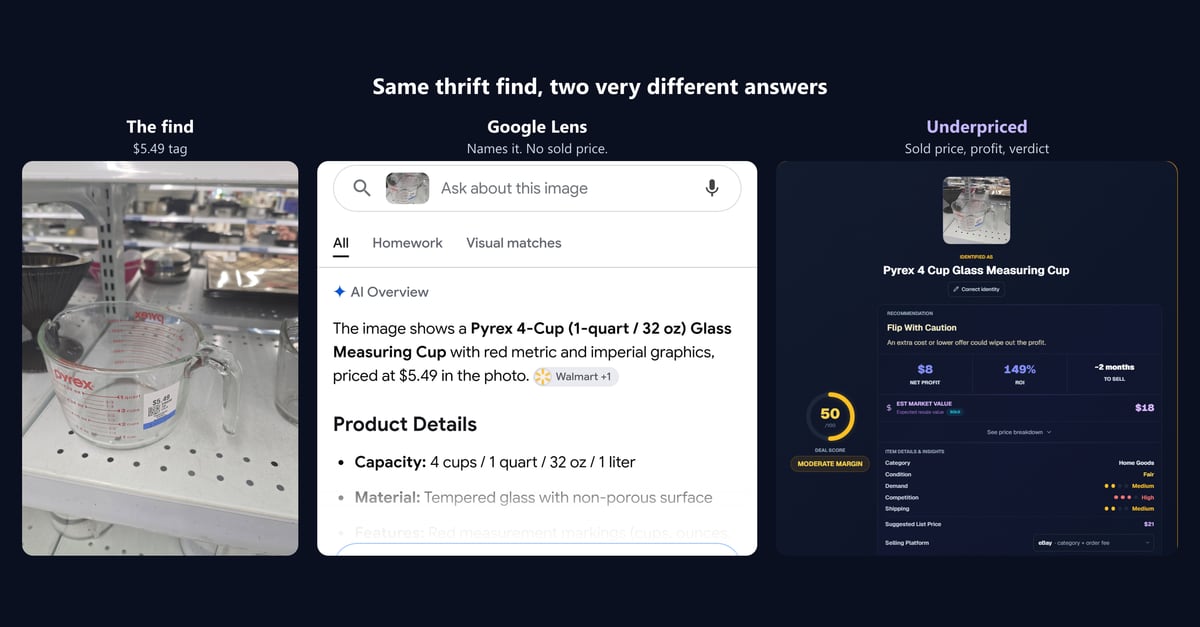
Google Lens tells you what something is. It doesn’t tell you what it sells for. We ran 29 real thrift store items through Lens and through Underpriced, a resale scanner, and checked every answer against what the items actually sold for on eBay.
Lens named 25 of 28 items exactly, in about 9 seconds each, for free. But it never once showed a used sold price. Every price it showed was a new retail price, an ad or a single asking price, often several times what the item really sells for.
Underpriced also named 25 of 28 exactly (missing different items than Lens did), then did the part Lens leaves to you: it found what each item sold for, took off the fees and shipping, and said whether to buy at the tag price. Its values came within 25% of the real sold price on 9 of the 11 items we could check, and it got every obvious buy-or-skip call right.
So Lens is a great free way to get a name. When the tag price in your hand is the decision, you need sold prices and the math, and that’s what a resale scanner is for.
Disclosure: we make Underpriced. Both apps saw the same thrift finds, and we checked every answer against eBay sold prices we looked up by hand.
The short version
| Google Lens | Underpriced | |
|---|---|---|
| Named the item exactly (28 items) | 25 | 25 |
| Showed what it sells for used | 0 of 29 | 29 of 29 |
| Value within 25% of the real sold price (11 items) | doesn’t give a resale value | 9 of 11 |
| Typical miss on value | n/a | 11% |
| Profit at your tag price, after fees and shipping | no | yes |
| Buy or skip advice | none | right on all 4 obvious calls |
| Shows the sales behind the number | no | yes, with sale dates and shipping |
| Seconds per item | 9 | 39 |
| Cost | Free | 5 free analyses, no card; then from $9.99 a month |
Why “11 items” and “28 items”? Only 11 of the 29 had at least five matching eBay sales in the last 90 days, enough to know the real price, so values are checked on those. And one item, a die-cast toy car, we couldn’t identify for certain ourselves, so names are checked on 28.
What Lens showed instead of a resale value
Lens put a price on 21 of the 29 items. None of them was a used sold price:
| Item | What Lens showed | What it actually sells for on eBay, used | What Underpriced said |
|---|---|---|---|
| Sharp EL-2192RII printing calculator | Shop listings from about $77 to $137 | $16.98 (median of 10 sales) | $13 |
| Steve Jobs by Walter Isaacson, hardcover | Listings and shop prices, about $16 to $44 | $5.00 (median of 15 sales) | $6 |
| Pyrex 4-cup measuring cup | New ones on Amazon, about $22 to $28 | $19.00 (median of 134 sales) | $18 |
Price the calculator from what Lens showed and a $9.99 tag looks like a steal. At $17 sold, after eBay’s cut, it’s a couple of dollars of profit at best. Mixing up asking prices and sold prices is the most expensive mistake in thrifting, and it’s exactly the mistake Lens sets you up for.

What a resale scanner adds
Here’s what Underpriced gave us on each item that Lens didn’t:
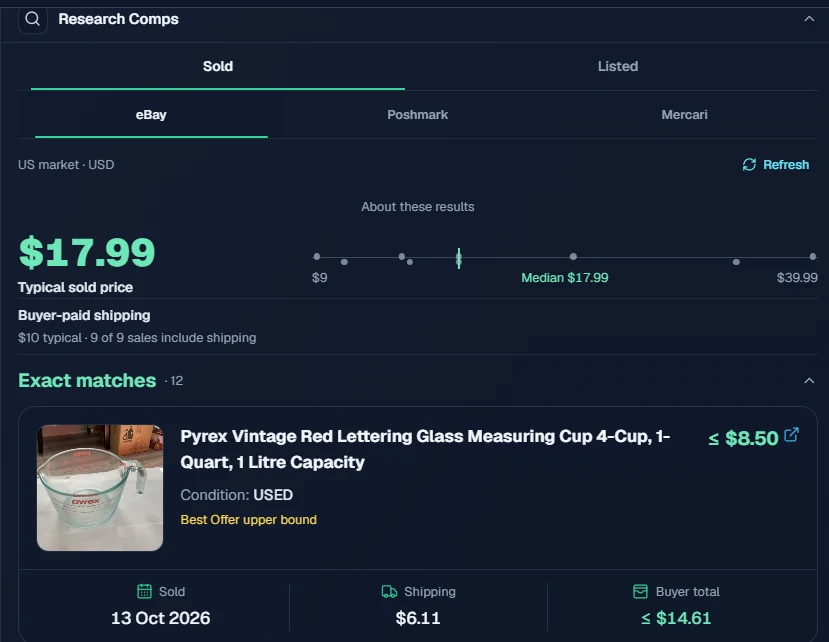
- The sold price, with receipts. The typical sold price of matching items, with every sale listed underneath: photo, title, price, sale date, shipping and what the buyer paid in total. Tap any sale to check it yourself.
- Best offers handled. When a sale went through on a best offer, eBay shows the asking price, not what the buyer paid. Underpriced flags those as an upper bound instead of counting them at face value.
- More than eBay. Sold prices from eBay, Poshmark and Mercari, plus current listings, so you can see what’s selling and what’s sitting.
- What you keep. Profit at your tag price after the marketplace fee and shipping. You pick the marketplace and who pays shipping, and it charges eBay’s fee the way eBay does: on the item, the shipping and the sales tax.
- A clear call. Flip It, Flip With Caution or Pass, with a deal score, a rough time to sell and the reason. When there aren’t enough matching sales to trust a number, it says so.
- A head start on the listing. A suggested list price and listing drafts for when you get home.
- Several at a time. Batch Mode runs 3 items at once on Reseller and up to 7 on Ultra.
The math Lens leaves to you
Take the Pyrex measuring cup with a $5.49 tag:
- It sells for $19.00 on eBay.
- The buyer pays about $10 shipping, which covers your label. But eBay charges its fee on the shipping and the sales tax too.
- eBay’s fee: 13.6% of about $31 (price, shipping and 7.5% tax), plus the $0.40 order fee, comes to about $4.64.
- You keep about $8.87.
Underpriced did all of that in one scan and said Flip With Caution at $18. With Lens you’d get the name in seconds, then open eBay, filter to sold, skim past the wrong sizes and colors, and do the fee math on your phone. It works. It’s just a few minutes per item, and that adds up fast over a cart.

If you’d rather do it by hand, our free eBay sold listings search and flip profit calculator cover it.
Where each one got the name wrong
Neither was perfect on names, and they missed different things. Both nailed everything with a printed model number, barcode or ISBN: the calculator, the DVDs and the books.
| Item | Google Lens | Underpriced |
|---|---|---|
| Lightning McQueen kids jacket | Jumpsuit costume | Disney Store racing jacket (right) |
| Amber and teal art glass vase | Couldn’t decide between ceramic and glass | Art glass (right) |
| KitchenAid Dutch oven | KitchenAid (right) | Le Creuset; the name on the lid handle is tiny |
| “Varadero Cuba” wine bottle holder | Cuban drinks table (close) | Tripod stool |
| Columbia half-zip fleece | Full zip | Full zip |
What each one really costs
Lens is free. The cost is your time: for every item you search eBay, filter to sold, skip the bad matches and work out the fees. That’s fine for one find and slow for a cart of twenty.
Underpriced gives you 5 free analyses with no card. After that, Reseller is $9.99 a month for 75 analyses (first month $4.99), about 13 cents an item, and Pro is $14.99 for 200. One avoided bad buy, like the $20.99 pair of flats in our test that would lose about $3.50 after fees, covers a good part of a month.
When Google Lens is enough
- You already know roughly what the item sells for and just need the exact name or model.
- You’re checking one or two things and don’t mind searching sold listings yourself.
- You’re decluttering, not buying, so there’s no tag price to beat.
When you want a resale scanner
- You’re in an aisle with a cart and want a buy or skip on each item.
- The item is unbranded or decorative, and typing a search gives you junk.
- You keep overpaying because asking prices look like sold prices.
- You want fees and shipping worked out the same way every time, and the listing half-written when you get home.
Try Underpriced on one of your own finds: the first 5 analyses are free, no card needed.
How we tested
We photographed 29 items at Value Village and the Salvation Army between Sep 20 and Oct 8, 2026, with one to three photos each: the whole item, plus the tag, label or marks where there were any. Underpriced got all of an item’s photos and its tag price. Lens got the main photo of each item, the way most people use it: point the camera and read the answer.
For the real price we searched eBay sold listings by hand for each item: sold in the last 90 days, pre-owned, exact matches only, leaving out accepted best offers because eBay shows the asking price on those. A value counts as close when it’s within 25% of the median sold price, or when the median falls inside the app’s range. A name counts as exact when the brand or maker and the type of item are right and nothing in the photos says otherwise. Buy-or-skip advice was only scored where the answer was obvious: at least $3 of profit or loss after eBay’s fee on price, shipping and tax.
Google Lens ran free in the Google app on Oct 10, 2026. Underpriced ran on a paid plan in the web app on Oct 13, 2026, with shipping set to Buyer pays.
Frequently Asked Questions
Does Google Lens show resale value?
No. In our test it showed a price on 21 of 29 items, and every one was a new retail price, an ad or a single asking price. None was a used sold price. Use Lens for the name, then check what it actually sold for.
Is Google Lens good for thrifting?
For identification, yes: it named 25 of 28 items exactly, in about 9 seconds, for free. It won’t tell you whether an item is worth buying at the tag price, so pair it with a sold-price search or a resale scanner.
How accurate is Underpriced on value?
On the 11 items with enough eBay sales to know the real price, Underpriced came within 25% of the median sold price on 9, with a typical miss of 11%, and it got all 4 obvious buy-or-skip calls right.
Why do the prices in Google Lens look so high?
Lens shows shopping results: new items and asking prices. Used items usually sell for much less. In our test, Lens showed the Sharp calculator in listings from about $77 to $137, and it sells for about $17 used.
Related guides
Related articles
reseller apps tested on thrift finds
We ran 29 thrift store items through five reseller apps and graded them against eBay sold prices. Results, prices for 10 apps, features compared and which app fits which job.
Thrift AI review
ThriftAI: Profit Identifier costs $9.99 a month after a 3-day trial. We tested it on 29 thrift store items against eBay sold prices and our own app. Its names were good; its values ran high.
how to use eBay sold listings for pricing
Master eBay sold listings for accurate pricing. Learn sold vs completed data, average vs median pricing, Terapeak, sell-through rates, and comp research strategies for smarter reselling decisions.
Tools that help with this topic
eBay sold listings search
Build source-backed sold-comp research links for eBay Advanced Search, eBay Product Research, Mercari, and Poshmark, plus a 7-comp pricing worksheet.
flip profit calculator
Calculate net profit, ROI, margin, break-even price, and target sale price after marketplace fees, shipping, reserves, and labor. Free calculator included.
Pyrex Value Guide
What 24 vintage Pyrex patterns sold for on eBay from July to October 2026, one piece and sets, plus a quick check for the piece in your hand.